
Probability Distribution
Submitted by kmkan28 on Sun, 03/03/2013 - 14:24
Hi,
This is a question i have taken from a question bank.Please give me answer and the explanation.
The cost estimatesof a proposed project has an expected value of 1000000 and a standard deviation of 50000.The project is budgeted for 1100000 so as to include a contingency reserve.Assuming that the cost estimates are normally distributed,what is the probability of completing this project over budget?
A.0.1
B.0.05
C.0.025
D.05
Forums:


sspawar
Sun, 03/03/2013 - 16:25
Permalink
C
C
kmkan28
Sun, 03/03/2013 - 16:39
Permalink
Absolutely correct!
Dear pawar!,
This is the answer given in the portal also.But we need your explanation.
sspawar
Sun, 03/03/2013 - 17:22
Permalink
Question is asking that what
Question
is asking that what is probability that work completion amount may ecceed the BAC.
you know contingency reserve is part of baseline / BAC.
Expected value ( Mean) = 1000000
SD = 50000
BAC = 1100000 = 1000000 + (2*50000) = MEAN + 2SD
With this amount Probability of work completion under budget or on budget is = 50% + (95/2)%
= 97.5 %
or = 0.975
Probability that work completion amount may ecceed the BAC (1100000) = 1-0.975 = 0.025
pradipchavan82
Mon, 03/04/2013 - 18:44
Permalink
Why did we choose 2SD here
SSPAWAR, Thanks for your explanation. My question to you is why did we choose 2SD in your explanation.
Can;t it it be 1SD?
sspawar
Tue, 03/05/2013 - 04:54
Permalink
Bks contingency amount is
Bks contingency amount is 100000 above expected value (mean) and it is equivelant of = 2*50000 = 2sigma = 2SD.
Here dont confuse with 2sd = +/- 1sd either side of mean, 100000 (2sigma) is completely right side of mean value (1000000).
kmkan28
Tue, 03/05/2013 - 14:36
Permalink
Thank you
Pawar,
I just wanted to ask the same question.Great reply.
Mani
amar
Thu, 03/07/2013 - 19:45
Permalink
which formula did you use?
Hi sspawar,
I didn't get the :
work completion under budget or on budget is = 50% + (95/2)%
Which formula is this. I understand 95 refers to 2SD..please explain.
Thanks.
sspawar
Fri, 03/08/2013 - 02:25
Permalink
68.26 % is for +/-1SD95.45%
68.26 % is for +/-1SD
95.45% is for +/- 2SD
99.73 % is for +/-3SD
99.9996% is for +/-6SD
------------------------------------
68.26 = 34.13 % left side of Mean (Middle pick) equivelant to (-1SD), and 34.13 %right side of Mean (Middle pick) equivelant to (+1SD),
like wise
95 = 4sd and 95/2 = 2sd
amar
Fri, 03/08/2013 - 05:02
Permalink
Tough one
I am still trying to understand this. I am sure I need more time. Not sure exactly how the 50% came in the calculation.
Thanks.
sspawar
Fri, 03/08/2013 - 08:02
Permalink
It is supposed that Complete
It is supposed that Complete area below bell shape curve = 1 unit = 100%
Left side of Mean (middle pick) will be half of this = 0.50unit = 50%
Right side of Mean (middle pick) will be half of this = 0.50unit = 50%
Now it is also fixed that
Left side of 34.13% area have a fixed distance from mean = one SD, though it is LHS of mean hence called -1SD
Right side of 34.13% area have a fixed distance from mean = one SD, though it is RHS of mean hence called +1SD
Adding both 68.26% equally spreaded both side of mean will have = +1SD and -1SD distance = +/- 1 SD = inactual this distance will be 2SD
Like for Area 99.73% (49.87% +49.87), +/- 3SD = 3SD left +3SD right = 6SD distance
See both figure of dated 29May12 in blog
er-sspawar.blogspot.in
bkthakkar
Sat, 03/09/2013 - 02:19
Permalink
Great answer.. strong
Great answer.. strong fundamentals
sspawar
Fri, 03/08/2013 - 08:27
Permalink
Normal Distribution Data can
Normal Distribution
Data can be "distributed" (spread out) in different ways.
It can be spread out more on the left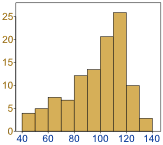 ... or more on the right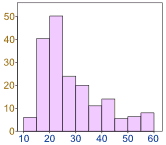
Or it can be all jumbled up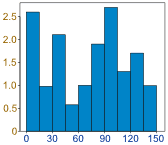
But there are many cases where the data tends to be around a central value with no bias left or right, and it gets close to a "Normal Distribution" like this:
A Normal Distribution
The "Bell Curve" is a Normal Distribution.
And the yellow histogram shows some data that follows it closely, but not perfectly (which is usual).
because it looks like a bell.
sspawar
Fri, 03/08/2013 - 09:07
Permalink
In More Detail
In More Detail
Here is the Standard Normal Distribution with percentages for every half of a standard deviation, and cumulative percentages:
Example: Your score in a recent test was 0.5 standard deviations above the average, how many people scored lower than you did?
So the total less than you is:
50% + 19.1% = 69.1%
In theory 69.1% scored less than you did (but with real data the percentage may be different)
amar
Fri, 03/08/2013 - 16:10
Permalink
This helped
This really helped me. It's better to remember this concept and apply if it ever appear. But hard to think such complex question will appear in exam. You must be an expert in statistics as well. Thanks for explaining sir.